 https://orcid.org/0000-0002-8397-8287

Figures
Abstract
Floods and droughts cause large economic and environmental impacts and incalculable human suffering. Despite growing evidence of important synergies in their management, floods and droughts tend to be mostly managed in silos. The synergistic management of flood and drought risk is limited by the inability of current governance systems to change at the scope, depth and speed required to address the emerging challenges of climate change induced hydroclimatic risks. Building on the concept of continuous transformational change and combining key elements across sectoral governance frameworks, this paper proposes a transformative governance conceptual framework that enables national governments to work across silos in a whole of government approach to lead a whole of society effort to manage the whole hydroclimatic spectrum. Spain, a country with an advanced hydroclimatic risk management system, is presented as an illustrative example to explore the possible idiosyncrasies of implementing the proposed changes on the ground.
Citation: Núñez Sánchez A, Koehler J, Van Loon AF (2025) Managing floods and droughts synergistically: A transformative governance approach. PLOS Water 4(8): e0000417. https://doi.org/10.1371/journal.pwat.0000417
Editor: Majid Shafiee-Jood, University of Virginia, UNITED STATES OF AMERICA
Published: August 19, 2025
Copyright: © 2025 Núñez Sánchez et al. This is an open access article distributed under the terms of the Creative Commons Attribution License, which permits unrestricted use, distribution, and reproduction in any medium, provided the original author and source are credited.
Funding: The authors received no specific funding for this work.
Competing interests: The authors have declared that no competing interests exist.
Introduction
In recent years, floods and droughts have affected over 3.4 billion people [1], caused more than a trillion dollars in damages [2,3] claimed hundreds of thousands of lives [4–6], and caused immense human suffering [7]. In 2023, the World Economic Forum considered floods and droughts as an ongoing global risk causing negative impacts for a significant proportion of the world’s population, ecosystems and gross domestic product [8]. Floods and droughts have been widely recognized as inhibitors of sustainable development, hindering or decimating development gains [3,9,10]. Furthermore, flood and drought impacts increasingly cascade across geographies and sectors, and can have inter-generational implications in equality, poverty, migration and conflict [11–14].
The increasing risks of floods and droughts represent some of the most immediate and harmful consequences of climate change [2,7]. A continuing warming climate is expected to cause long-lasting variations in all components of the hydroclimatic spectrum, increasing the likelihood of severe, pervasive and irreversible impacts on people, economies and ecosystems [15,16]. In the next century, floods and droughts will become more frequent in every region in the world with increased intensity, duration and/or spatial extent, even under low-emission scenarios [17,18].
Governments around the world are carrying out efforts to better manage floods and droughts [18]. Despite progress, increased impacts are outpacing risk mitigation and adaptation efforts [2,18]. There is a growing concern that current governance systems are ill equipped to face the increased risks posed by climate change induced floods and droughts [16,19–23]. Moreover, the way in which governments tackle flood and drought risks can promote resilience, or can, in turn, become root causes, drivers, and amplifiers of their social, environmental and economic impacts [3,14,24]. A key shortcoming emerging from the literature suggests that government agencies are managing floods and droughts solely within their mandates and rarely collaborate, making it much harder to seize the opportunities of protecting against both floods and droughts. For example, wetland conservation led by the environmental agency can reduce flood and drought hazards, thereby reducing the risk faced by communities that the disaster risk management agency is mandated to protect [2,7,11,25].
While there is an emerging consensus on the need to transform governance systems to face the challenges posed by increasing hydroclimatic risks, the literature offers limited clarity on how such transformations can be affectively achieved in practice. This paper attempts to contribute to the ongoing conversation about what governance approaches and interventions facilitate change towards the synergistic management of floods and droughts [20,22,26]. The synergistic management of floods and droughts refers to a collaborative effort between government and society to achieve a common resilience objective.
This paper is explorative in nature and aims at tackling the question: “What are the changes required in existing governance systems to enable the synergistic management of floods and droughts?” To tackle this question, the paper first develops a narrative review of key scientific and grey literature related to the sectoral frameworks underpinning flood and drought governance, starting with water resources management, disaster risk management, climate change adaptation and zooming into flood and drought risk management. The narrative review illustrates that none of these disciplines provides sufficient grouping to manage floods and droughts in isolation. It then identifies key features in each discipline that can inform the changes required in existing governance systems to enable the synergistic management of floods and droughts.
The paper then builds on the concept of continuous transformational change [27–31] and combines the identified key features across sectoral frameworks to propose a new conceptual framework for hydroclimatic risk management governance based on three transformative pathways: institutional arrangements –referred to as whole of government; patterns of interaction –referred to as whole of society; and paradigms –referred to the whole hydroclimatic spectrum.
Lastly, based on key scientific and grey literature and policy documents, this paper presents Spain as an illustrative example to explore practical elements associated with implementing such transformative pathways in practice. Spain suffers from both floods and droughts, has an advanced hydro-climatic risk management system and has taken concerted efforts in the proposed three transformative pathways.
This paper builds on elements of the report ‘An EPIC Response: Innovative Governance for Flood and Drought Risk Management,’ [7] providing a broader theoretical foundation on transformational change alongside a scholarly synthesis of the literature concerning the governance of flood and drought risk management.
Flood and Drought risk governance: A narrative review of different disciplines
The governance of floods and droughts does not stem from a single school of thought but rather emerges from subcomponents within diverse sectoral frameworks such as water resources management (WRM), disaster risk management (DRM), and climate adaptation governance, to name a few [20]. These sectoral frameworks address a broader array of issues beyond floods and droughts, such as water quality and allocation in the case of WRM, pandemics or terrorism for DRM, or ecosystem loss and intergenerational impacts for climate adaptation governance.
To inform the conceptual development of this paper, a narrative review synthesizes the governance dimensions of floods and droughts, identifying and grouping relevant elements across selected sectoral frameworks (i.e., WRM, DRM, adaptation governance, flood risk management and drought risk management) into a common analytical space. The literature search strategy combined key terms such as “flood,” “drought,” and “governance,” with selected sectoral frameworks including “water resources management,” “disaster risk management,” and “climate adaptation.” Searches were carried out primarily using the SCOPUS database in combination with the Research Rabbit application linked to the Zotero reference manager. This grouping allowed for the exploration of citation networks and the identification of relevant literature clusters, supporting a chronological and thematic mapping of research at the intersection of flood, drought and governance. This process guided the selection of literature that met the following criteria: (i) how floods and droughts are conceptualized within each sectoral framework; and (ii) the extent to which governance aspects are addressed in sectoral approaches to floods and droughts.
The narrative review was structured around two lines of inquiry: i) what are the shortcomings of individual sectoral governance frameworks when applied in isolation, and how do these limitations hinder the synergistic management of floods and droughts?; and ii) which key features from each sectoral framework are relevant to enable such synergistic management, and how can these key features be grouped to inform the changes required in existing governance systems for the synergistic management of floods and droughts?
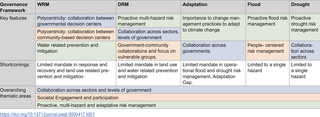
In the subsections that follow, the findings of the narrative review are organized by sectoral framework, with key insights summarized in Table 1. The findings of the narrative review serve as key inputs for the second part of this paper, which presents and elaborates the proposed conceptual framework.
Water resources management governance: key features and shortcomings for hydroclimatic risk management
The evolution of Integrated WRM governance continues to benefit from academic debate and expanding practice [32,33]. Normative WRM governance literature – focused in generating principles and standards – and practitioner WRM governance literature – focused on experimentation – have coexisted and evolved, building on analytical studies and practice. From the 1960s to the late 1980s, there was a common presumption that strong central governments were best placed to command and control the management of resources and avoid their overuse and ultimate destruction [30,34]. Since then, there has been a trend moving away from normative and centralized water governance systems to approaches that build on diverse local practices [35–37].
Normative WRM governance literature has changed over time, moving from concepts such as the Dublin Principles for integrated water resources management – highlighting the importance of basin planning, participation, and the notion of water as a scarce economic good – to the incorporation of new concepts and/or the redefinition of others – such as water security, social inclusion, climate resilience or the food-energy-environment nexus [32,38–40]. This change has been informed by areas such as common pool resources management and socio-ecological systems, participatory decentralization and co-management, among others [26,41,42]. Given that WRM governance is a highly contextual and ever changing approach, influenced by physical factors, levels of economic and social development as well as political and cultural norms, efforts to promote normative approaches such as Dublin Principles or those emerging from other global water conventions are considered to have delivered limited practical impact [32,33,41].
Practitioner WRM literature argues that the diversity of challenges, institutional frameworks, changing dynamics and contexts, prevents generalizations. The proliferation of practitioner literature demonstrates the capacity of local governments and civil society organizations to manage and conserve natural resources, thereby challenging centralist and normative approaches in favor of polycentric government systems [34].
Polycentric governance systems consist of a network of nested decision centers at multiple levels coupled with an overall framework that enables coordination among them [34,40]. Polycentricity steers away from centralized normative governance systems to allow for a variety of coordinated approaches between different decision centers that deliver results to local populations [39,43]. Positive characteristics of polycentric governance systems include enabling collaboration within and across government levels to better meet local needs [35]. A plethora of literature on practical applications seems to point out the robustness of such an approach in a variety of socio-ecological systems including water and the environment [44], water and agriculture [35,45,46], water and drought [47,48], water and disaster risk management [20,49], and more recently, floods and droughts [13,50].
Polycentricity is a key feature of WRM with potential application to the nested decision centers needed to manage floods and droughts, such as sectoral government agencies or communities. However, further study is required to identify and describe the overarching framework that enables collaboration between these decision centers, particularly in the context of hydroclimatic risk management, as well as to better understand the challenges associated with implementation [50].
While WRM plays a critical role in the proactive management of floods and droughts, it remains insufficient as a standalone approach to fully manage them. A key shortcoming arises during the post-disaster response and recovery phases, where WRM tends to play a secondary role and other frameworks such as DRM assume greater prominence [7]. In the particular case of proactive drought risk management, land use management becomes central, and sectors like agriculture and natural resources management emerge as essential players in decision-making [51,52].
Disaster risk management governance: key features and shortcomings for hydroclimatic risk management
Modern DRM governance has evolved rapidly building from a focus on response and recovery to proactive prevention, mitigation, and preparedness [5]. Best practices in DRM governance generally involve a decentralized effort focused in building a synergistic multi-level and multi-sector network of stakeholders at all stages of the risk management cycle [53].
Particularly for hydroclimatic risks, governments have historically focused on responding to and recovering from floods and droughts, often neglecting the underlying causes that turn natural hazards into human disasters [11,49,53,54]. This dynamic is described by Wilhite as the hydro-illogical circle, focusing on drought risk management. The hydro-illogical circle captures a recurrent pattern in which a surge of urgent activity and policy attention follows a drought, only to be replaced by a period of apathy once it rains and the immediate shock subsides. As the disaster fades from public and political focus, other priorities dominate the agenda, resulting in limited sustained preparation for the next drought disaster [55]. An interesting counterargument is emerging in the literature, highlighting the connections between disaster-related crises and opportunities for transformative change. For example, severe floods have, in some cases, triggered a paradigm shift in flood management [19,56]. Although more research is needed to analyze in which conditions disasters can enable changes, current evidence emphasizes how crises can foster strategic collaborations at the local and national level to trigger and steer changes towards more resilient development trajectories [36,57].
An increasingly recognized DRM paradigm moves from reactive response to proactive risk reduction [58]. This new approach is perhaps best captured in the Sendai Framework on Disaster Risk Reduction 2015–2030 which focuses on the adoption of measures that address all dimensions of disaster risk (i.e., hazard, exposure, and vulnerability) including prevention, mitigation, preparedness, response, recovery, and rehabilitation [59]. The Sendai Framework, builds on the previous Hyogo Framework for Action 2005–2015, which highlighted the need to strengthen disaster-risk governance as a lesson learned and a future challenge [60]. As such, the Sendai Framework places the strengthening of governance as one of its four priorities to manage disaster risk [59].
Modern DRM literature includes key concepts such as whole-systems approach – incorporating multiple elements, causes and effects, feedback loops and cascading impacts – and a focus on those more vulnerable as core principles [14,59]. Importantly, DRM highlights the importance of collaboration among key stakeholders such as government, citizens, the scientific community, the private sector and those most vulnerable to prepare, respond and recover to disasters [14,53,59,61,62]. Finally, the traditional risk paradigm that focuses on single hazards and risks faced by a particular community or economic sector is giving way to multi-hazard strategies and a better understanding of the interconnection between multiple risks and their associated impacts [63].
DRM key features – such as proactive multi-hazard risk management, cross- sectoral and multilevel governance collaboration, strong partnerships between government and communities, and a focus on vulnerable populations – are highly relevant for the synergistic management of floods and drought. Yet additional analysis is needed to deepen understanding of the conceptual and operational implications associated with feedback mechanisms between floods and droughts, both as multi-hazards and in the context of their proactive and holistic management [9,26].
DRM theory and practice are cornerstone in managing the response and recovery of floods and droughts and place an important focus on the need to further develop prevention, mitigation, and preparedness. Yet DRM in isolation is insufficient to comprehensively address all risk management stages across the entire hydroclimatic spectrum. A key shortcoming is particularly evident in the domains of prevention and mitigation, where core competences generally lie within other sectors such as WRM, agriculture, natural resources management, or finance. For example, the management of river basins or coastal zones for flood or drought risk management often falls outside the formal mandate of DRM agencies. Yet it is imperative for DRM agencies to actively collaborate with relevant sectors by bringing a necessary disaster risk management lens to sectoral strategies and operations [7].
Climate change adaptive governance: key features and shortcomings for hydroclimatic risk management
In addition to DRM governance focused on avoiding, minimizing and managing hydroclimatic risks, climate change adaptive governance has emerged more recently to focus on managing the evolving risks resulting from climate change both today and in the future [64]. Adaptive governance has its roots in resilience theory [36,41,65] and signifies the ability to change management practices to better cope with existing and future risks based on continuous learning and contextual information [26].
The detailed review of policies and strategies designed to adapt to climate change reveals that they often encounter an implementation gap [26,66,67]. Adaptive governance is well recognized as a concept but it is very hard to implement and sustain in practice [18,50,68,69]. The difficulties associated with adaptive governance are attributed to the inherent scientific uncertainties and diverse perception of risks associated with climate change [26,27,70]. Indeed, climate-induced risks exhibit characteristics of a wicked problem – a complex, unpredictable, open ended challenge that is resistant to solution [22,34,71,72] and that tends to neither have agreement on the problem itself nor on the solution [72].
As floods and drought risk will continue to increase due to climate change, a key feature of adaptive governance is that it brings the necessity to change in order to adapt to developing and uncertain circumstances to the forefront of its theoretical framework and focuses on the characteristics, drivers, and challenges of such change [29,73]. In addtion, adaptive governance has spearheaded an important collaborative process across nations in the form of international agreements highlighting and focusing on the process of mainstreaming climate change considerations across sectors at the national and transboundary level [68,74,75].
However, an important shortcoming is that adaptive governance, implemented in isolation, remains insufficient to manage hydroclimatic risks operationally. This limitation is reflected in the persistent adaptation gap, as periodically measured by the United Nations in its Adaptation Gap Report. The report highlights critical challenges such as a widening financial gap, fragmented institutional approaches, and the continued exclusion of vulnerable populations [66]. Flood and drought risk management, even if intimately impacted by climate change, are considered a more imminent and well perceived risk, increasing the likelihood of action and reducing their relative implementation gap [26,76]. Increasing the implementation of adaptive governance might require a fundamental change of institutions, perceptions and interactions – which often are reticent to change [69,77].
Flood and drought risk management: key features and shortcomings for hydroclimatic risk management
Flood risk management is deeply rooted in both water resources management and disaster risk management. Integrated WRM focuses in the management of land, water and risks at the basin level to maximize economic and social wellbeing [9]. The literature on the governance of floods is dominated by the disaster-risk focused prevention, mitigation, preparedness, response and recovery (PMPRR) framework [53].
Historically, governments have based flood prevention on infrastructure to reduce risks – perhaps as a legacy from the normative, centric, command-and-control approach to WRM – coupled with emergency management – or a reactive approach to DRM. As the DRM and WRM literature and practice have incrementally shifted their focus on the proactive management of flood risks, a key feature has been the growing the emphasis on people-centered non-structural flood risk management practices [9].
A key feature of flood risk PMPRR is the presence of water and disaster risk-related laws and institutions tasked with the overall responsibility of coordinating with a variety of actors within the national government and society to reduce flood hazard, exposure, and vulnerability. For example, the DRM agency might collaborate with the WRM agency for issues around infrastructure maintenance and operation, or with the hydrometeorology agency for flood observation and early warnings. The DRM agency often is also tasked with collaborating and organizing with local governments, scientific institutions and communities specially those most vulnerable on matters around contingency planning, flood observation and analysis and socially-inclusive flood risk management [7].
Droughts have also been addressed generally in a reactive manner, managing the crisis instead of proactively forecasting and managing the risk [9,51,78]. The disaster-risk centered PMPRR approach is less prevalent for drought, and when drought is presented within DRM it often focuses on response and recovery. This emphasis might be explained by the difficulties in declaring a slow-onset hazard a disaster [53]. Moreover, while drought might significantly impact agricultural production, floods are generally perceived as a more direct threat to public safety which may explain the DRM focus on floods.
The WRM approach to drought management has historically focused on the management of blue water, that is, the water stored in rivers, reservoirs, lakes, and groundwater aquifers [7]. However the modern conception of drought management includes the management of green water, or the water stored in unsaturated soil, absorbed by plants or evaporated from the soil [52]. Green water plays an irreplaceable role in global ecosystems and food production, accounting for around 80 percent of global food production and exclusively sustaining grassland and forest ecosystems [79,80].
A key feature of drought risk management is its reliance on cross-sectoral collaboration, requiring the active participation of meteorological and hydrological agencies, WRM, DRM, agriculture, natural resources management and finance sectors, to name a few [7,52,81]. As countries around the world attempt to move away from reactive to proactive approaches, there is abundant recognition of the need to develop drought policies that incentivize collaboration among different actors [51,82]. It is generally necessary to develop a specific drought risk management framework that goes beyond the sector-specific domains and seeks to coordinate and synergize the efforts of several different entities [7,52]. The High-Level Meeting on National Drought Policy of 2013, and the more recent one in 2024, highlighted the role of National Drought Policies as fundamental to enable collaboration among the different actors for proactive drought management and increased resilience [83,84].
Most research and practice on hydroclimatic risk management focuses either on flood risk or on drought risk. This siloed approach is a key shortcoming as it overlooks critical interactions and can result in unintended consequences and missed opportunities, limiting the synergistic management of the entire hydroclimatic spectrum [2,11,25]. Flood and drought can happen consecutively, or even simultaneously, exacerbating each other’s impacts and causing both cascading and ripple effects across different sectors and systems [85,86]. The most used approaches to understand the relationship between floods and drought are focused on the physical aspects and compounding impacts [2,11,19,24,25,87]. More research is needed to better understand why siloed flood and drought risk management persist, the associated negative consequences as well as the potential benefits of their synergistic management.
Analysis of the different governance frameworks: key features and shortcomings
The previous sections highlight that the governance of floods and droughts does not stem from a single school of thought but rather from key features across disciplines. At the same time, the narrative review points out shortcomings denoting that none of these sectoral governance frameworks in isolation are enough to manage the increasing risks emerging from floods and droughts.
The narrative review shows that significant variation exists among the sectoral governance frameworks underpinning flood and drought management in terms of their scope, focus, defining attributes, sense of urgency, and historical evolution. Some frameworks are spatially grounded and aligned with physical systems, such as a river basins, exemplified by WRM. Others operate at a national level, emphasizing systemic processes and institutional collaboration, as seen in DRM and climate change adaptation [34,53]. The degree of practical application also differs: while frameworks such as WRM and DRM are supported by extensive implementation experience, others such as Adaptative governance continue to grapple with significant and well documented implementation gaps [33,66,67]. The governance frameworks also vary in their focus on the disaster risk management cycle. DRM typically focuses on response and recovery, whereas WRM and flood and drought governance contribute in greater depth to prevention and mitigation efforts.
Despite their disciplinary differences, these sectoral governance frameworks include several key features that are highly relevant to the synergistic management of floods and droughts and that might otherwise be lost in siloed scholarly and operational differentiation [20]. Within WRM, DRM, and adaptive governance key features include an emphasis on cross-sectoral and multilevel collaboration, as well as the critical role of societal engagement. Both flood risk management and drought risk management stress the importance of operational collaboration across sectors as well as proactive approaches to risk management [25]. One of the DRM key features is its explicit emphasis on multi-hazard risks and their disproportionate impact on vulnerable populations, offering a more holistic and inclusive perspective on the interconnected nature of a variety of risks [85,88]. A key feature of adaptive governance is its emphasis on flexible and responsive management practices that change to meet evolving circumstances to better cope with existing and future risks [41,56,57].This paper clusters the identified key features across sectoral frameworks into three overarching thematic areas: i) collaboration across sectors and levels of government; ii) societal engagement and participation, including those most vulnerable; and iii) proactive, long term and multi-hazard risk management encompassing both floods and droughts. Table 1 summarizes the key features and shortcomings identified through the narrative review and highlights and consolidates main thematic areas across sectoral governance frameworks that hold potential for informing the synergistic management of floods and droughts [20].
The synergistic management of floods and drought represent a complex challenge that necessitates an equally complex governance approach [89]. Building on the overarching thematic areas identified above, this paper seeks to further explore and conceptualize the change processes required to manage hydroclimatic risks synergistically. The analysis in the next section examines the role of overarching thematic areas in facilitating such transformation and identifies transformational pathways through which the synergistic management of floods and droughts might be advanced.
Transforming the governance of flood and drought risk management
The synergistic management of flood and drought risk is limited by the inability of current governance systems to change at the scope, depth and speed needed to address the complex challenges posed by hydroclimatic risks [26,27,36,42,43,90,91]. The majority of current adaptation efforts fall into the category of incremental change, which consists of small, partial and slow modifications that maintain the functioning of an existing system [27,29,92]. However, there is an ongoing discussion around the need for a higher order of change, that is transformative change, requiring in-depth, large and faster variations that fundamentally modify existing hydroclimatic risk management systems so they are able to deal with the impacts of climate change, especially those expected in high emission scenarios [18,28,54,91].
Discussing change in binary terms, incremental vs transformative, might not be fruitful conceptually and does not necessarily lead to a better understanding of the governance interventions needed to enable change [91]. For example, the IPCC considers a continuum between incremental and transformative change with no sharp division between them as both are deeply related, bring us closer to a common resilience objective, and are likely to continue occurring simultaneously [15,18]. The IPCC Fifth Assessment Report (AR5) describes the term transformative change as: i) the aggregation or scaling up of limited interventions that individually do not exceed thresholds but together have transformative potential, ii) interventions only available when the there is no more room for incremental change; and iii) actions designed to address system failure [15].
Scholars like Termeer et al. (2017, 2024) have also challenged the rigid dichotomy between incremental and transformational change, which is based on assumptions related to the depth, scope and speed of change, introducing the concept of continuous transformational change. This concept refers to a process characterized by in-depth and sustained modifications to governance systems that enable new pathways for systemic and structural change [30,31,91,93]. Positioned between small-scale incremental change and large-scale radical change, continuous transformational change emphasizes the quality of continued change, rather than framing it within a binary of slow versus fast when referring to the speed of change [91,94]. Termeer and colleagues apply this concept to the governance interventions for climate change adaptation arguing that governing transformational change will require transformations of the governance systems themselves [91].
Transforming governance systems requires innovative approaches and the development of new governance practices that reshape power structures and institutional arrangements, reconfigure patterns of interaction to encourage collaboration, and challenge existing assumptions and mind-sets [27,29,43,91]. However, despite discussion on the characteristics of change, the existing scientific literature offers limited guidance on how to steer or facilitate the governance transformations required to leverage synergies in flood and drought risk management [92].
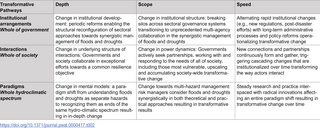
This section explores an innovative conceptual governance approach that builds on the overarching thematic areas emerging from the narrative review and the concept of continuous transformational change. It seeks to inform the necessary changes in institutional arrangements, interactions, and paradigms for the synergistic management of floods and droughts. This proposed governance approach focuses on three main transformative pathways: i) a shift of institutional arrangements from siloed sectoral management to interagency collaboration at the national level –referred to as a whole of government approach; ii) a reconfiguration of the patterns of interaction between national governments and society to foster efforts towards a shared resilience objective – referred to as a whole of society approach; and iii) a paradigm shift from treating floods and droughts as separate risks to understanding them as interconnected phenomena along a single hydroclimatic spectrum – referred to as the whole hydroclimatic spectrum. Table 2 outlines these proposed transformative pathways and illustrates how they align with the key dimensions of change (i.e., depth, scope and speed) offering a nuanced narrative of how transformation can be realized.
To illustrate how the three proposed transformative pathways might occur in practice, this paper draws on descriptive examples from flood and drought risk management in Spain. Each of the following sections introduces key concepts from the related literature to each proposed transformative pathway (i.e., whole of government, whole of society, and whole hydroclimatic spectrum) and applies these concepts in the illustrative example of Spain.
Whole of government
National governments are at the core of countries’ capacity to deal with current and future climate extremes [31,54]. However, no single government agency can effectively manage the complex and interconnected challenges posed by hydroclimatic risks in isolation. The term whole of government refers to the collaboration required among various government agencies to manage complex challenges. The concept operationalizes polycentricity from the perspective of national governments, understanding the different agencies as autonomous yet inter-linked decision centers and highlighting the need to align mandates and incentives to enable effective collaboration [34,35,89].
Governments have direct capacity to transform agencies and practices to facilitate increased collaboration towards a shared adaptation goal [31,95]. Whole of government approaches have been utilized by national governments as a way to organize internal collaboration to tackle wicked problems throughout the 19th and 20th centuries [96]. More recently, the USA and Australian governments have utilized whole of government approaches to increase collaboration between agencies involved in responding to climate change [95,97].
Enhancing collaboration in practice requires a clear understanding of commonalities in governance structures, as well as strategies that have proven effective in driving transformative change [31,64]. While further practice and analysis are needed to identify the key enabling characteristics of whole of government approaches, particularly in the context of flood and drought risk management, some emerging practices show promise. For example, there is growing evidence that the periodic preparation of strategic national plans for water, disaster risk management and drought management can play a critical role in facilitating interagency collaboration [7]. These national strategic planning processes, often mandated by law, provide a structured opportunity for different agencies to convene to periodically and progressively enable changes in policies, laws, programs, regulations, funding and, interagency collaboration arrangements [64].
In Spain, there are key developments in place enabling continued change towards a whole of government effort for flood and drought risk management although the term itself has not been formally adopted. Most aspects related to floods and droughts are governed by the Spanish WRM and the DRM legal frameworks. Within this context, the 2001 Water Law and the 2015 Civil Protection Law both mandate the periodic preparation of national strategic plans for water resources and disaster risk management, requiring the involvement of agencies across multiple sectors [98–100]. However, the extent to which these periodic planning process effectively enable a whole of government approach remains to be fully determined.
On the WRM side, the law requires the National Hydrological Plan to serve two key functions: to periodically revise the national water sector strategy and approve and harmonize basin plans. Spain’s first National Hydrologic Plan, adopted in 2001, set out a national infrastructure-based water transfer strategy which generated strong stakeholder opposition. In 2005, a new administration revised the Plan, shifting its focus in favor of desalinization efforts [52,98,100,101]. Since then, no National Strategic Water Plan has been developed. Instead the focus has shifted to the targeted approval of updated river basin plans, without a formal revision of the overarching national water strategy. As a result, opportunities to advance transformative change toward increased inter-agency collaboration for flood and drought risk management remain largely unrealized.
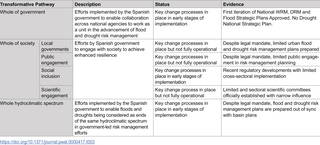
On the DRM side, the national committee for civil protection approved Spain’s first National Civil Protection Strategy in 2019 which highlights flooding, and to a lesser extent drought, as significant national risks [102]. A National Flood Management Strategic Plan was previously adopted by the cabinet in 2011 [103]. Spain currently lacks a National Drought Management Strategic Plan, although a comprehensive drought observation program is coordinated at the national level. Table 3 summarizes the main findings stemming from the application of transformative pathways, including whole of government to the illustrative example of Spain.
While Spain has developed national strategic plans for water, civil protection and flood management, these efforts have not yet been periodically updated to fully enable and operationalize the transformations necessary for the different sectoral agencies to engage in a whole of government approach to flood and drought risk management [104]. The legal mandates to prepare national strategic plans with the participation of the different agencies represent an important first step, as they establish a periodic multisectoral process with the potential to enable deep, system-wide change. However, since periodic and synergized strategic national plans for WRM, DRM and drought are not yet a reality in Spain, a longer-term operationalization process is still needed to fully implement this transformative governance change.
Whole of society
While necessary, whole of government approaches are not enough, as national governments are unable to manage the increasing challenges posed by floods and droughts in isolation. Building resilience requires the active participation of citizens, civil society, vulnerable groups, local governments, and the scientific community, in addition to collaborative action at the national level [59,105]. Emerging empirical evidence suggests that more complex and diverse interaction patterns, including multilevel collaboration between national and local governments and non-state actors, are associated with a higher level of adaptive capacity [24,43].
Engaging the whole of society, requires national agencies to move beyond a purely technocratic culture and incorporate social expertise [7]. By granting technical and social expertise equal standing, agencies are better placed to dynamically and flexibly respond to society’s evolving needs in the face of changing hydroclimatic risks [106,107]. Further analysis is required to understand and enhance the multiple and complex interactions required to engage the whole of society in the synergistic management of floods and droughts.
Building on the premise that flood and drought management are a shared responsibility involving the whole of society, this section focuses on the role of national government as leaders in reconfiguring interaction patterns and enabling active collaboration with key partners, including local governments, citizens, vulnerable groups, and the scientific community. A clear distinction is made between national and local governments recognizing that their mandates, capacity and agendas may differ. We argue that national governments should engage local governments as indispensable partners, rather than as subordinates, to align efforts in hydroclimatic risk management [50,108]. The following subsections delve into the conceptual foundations of whole of society efforts and draw examples from how the Spanish national government engages with each relevant partner (i.e., local governments, citizens, vulnerable groups, and the scientific community) in the management of floods and droughts. Table 3 summarizes the main findings from the application of the whole of society transformative pathway to the illustrative example of Spain disaggregated by relevant partner.
Local governments.
Local Governments play a key role in the management of floods and droughts, however their ability to execute their mandates is heavily influenced by institutional arrangements and the quality of collaboration between different entities [68,108]. As formally independent decision centers with their own set of administrative competences, local governments operate within a complex polycentric system in which they are functionally dependent on other decision centers. Decisions made at the national government may hinder or enable the range of flood and drought risk management actions available to local governments, for example by determining mandates and clear collaboration arrangements between local governments, basin authorities and other institutions such as disaster risk management, agricultural or environmental authorities [109]. This aligns with the findings of King-Okumu et al., (2018) and Pahl-Wostl and Knieper (2023) who emphasize that while increased local agency can contribute to manage floods and droughts, its effectiveness depends on the synergistic collaboration with national agencies [13,50].
The Spanish legal framework explicitly mandates local governments’ involvement in flood and drought risk management through two key mechanisms: basin planning processes led by the water sector, and contingency planning processes led by the disaster risk management sector [110–112]. Local government participation in flood and drought risk mitigation and contingency planning has expanded and evolved over time but is not yet fully operational. For example, under the Water Law, urban areas with populations exceeding 20,000 inhabitants are required to prepare urban drought risk management plans in coordination with basin-wide flood and drought risk management plans, aiming to align urban and basin level efforts. However, recent studies indicate that the development of urban drought risk management plans is still in early stages, with only 8.7% approved for interregional basins [113]. Despite a clear legal mandate and a mature basin planning practice enabling deep and system-wide change, the uncoordinated and untimely preparation of flood and drought risk mitigation plans at the basin and urban level has yet to generate the expected synergies in the combined management of hydroclimatic risks [104,113,114].
Public participation and stakeholder engagement.
Community involvement in floods and droughts management is essential to enabling transformations for a variety of reasons [59,62]. Stakeholders contribute important information to program design and evolution, their understanding and participation is crucial for implementation, and they play an important role in monitoring progress and providing feedback for continuous program improvement [89].
The timing of public participation and stakeholder engagement is particularly critical in the context of flood and drought risk management. For instance, competition over scarce resources often arises during a drought, at a time when management options are limited. Addressing such conflicts preemptively, during non-crisis periods, allows for more constructive dialogue, enabling stakeholders to better understand differing interests and values, and to identify mutually-agreeable improvements to existing systems [72]. The design and practice of public participation and stakeholder engagement are also fundamental, as poorly structured implementation can become a vehicle for elite capture, amplifying the voices of the privileged while underrepresenting marginalized groups [7].
Stakeholder engagement in Spain gained momentum with the adoption of the European Water Framework Directive (WFD), which highlights the need for active stakeholder participation in the development, review, and revision of river basin plans [115]. Spain legally internalized the WFD in 2003, incorporating provisions to support implementation specially around public participation, consultation and access to information in basin planning. These provisions were further reinforced in 2010 through the establishment of Flood Risk Management Planning public information and consultation processes [116,117].
Despite these important developments, public participation remains an evolving practice in Spain [107,118,119]. A recent analysis of 14 Flood Risk Management Plans in Spain reveals that stakeholder engagement often suffers from procedural rigidity and superficiality, limiting the inclusion of a broad spectrum of actors in meaningful public deliberation [119]. Research highlights the important of inter-institutional collaboration, clear stakeholder engagement guidelines, and an emphasis on engaging a wider pool of stakeholders as key to advancing public participation [118]. While legal mandates to engage stakeholders and enable access to information are important steps enabling in-depth change in public participation, realizing transformative change in flood and drought risk management will require broadening the scope of stakeholder engagement and further institutionalizing participatory practices to support more inclusive and effective interactions.
Social Inclusion.
Floods and droughts impact different segments of society in distinct and unequal ways [3,120]. Marginalized populations are frequently more exposed and more vulnerable to hazards due to substandard living conditions, limited access to healthcare, education, economic opportunities as well as a higher dependency on natural systems for their livelihoods [62]. Social exclusion can amplify the adverse impacts of floods and droughts on these groups, leading not only to disproportionate immediate losses but also to long-term socioeconomic consequences [24,121]. These impacts are often exacerbated by flood and drought risk mitigation and contingency programs focused on protecting high-value assets or saving lives, without adequately addressing the livelihood needs of socially-excluded communities [3]
In every country in the world, certain groups are excluded from fully participating in social, political or economic activities [62]. The nature of this exclusion varies by context and can be based on factors such as gender, sexual orientation, religion, socioeconomic status, disability, or immigration status. Addressing the impacts of floods and droughts on vulnerable populations requires transformative approaches that challenge prevailing risk perceptions, question entrenched assumptions, and critically examine fixed values, identities and stereotypes [92,122]. Sectoral agencies have a responsibility to develop nuanced programs that identify and characterize exclusion dynamics and design tailored services that address the specific needs of vulnerable communities. The establishment of dedicated social units within sectoral agencies tasked with operationalizing equity in flood and drought risk management programs is emerging as a good practice [7].
The Spanish Government is making a concerted effort to integrate considerations of social vulnerability in their recent disaster risk and climate adaptation programs. The original disaster risk management laws, enacted in 1985 and 1992, did not explicitly address the importance of social inclusion [112,123]. However, recent legal and regulatory developments, such as the 2021 Climate Change and Energy Transition Law and the Urban Drought Risk Management Planning Guidelines, mandate national agencies to mainstream social inclusion across government sectors and levels [124–128]. Moreover, the Ministry of Social Inclusion, Social Security, and Migration recently approved targeted measures to protect and support vulnerable communities affected by the 2024 catastrophic floods in Valencia [129]. These efforts represent a promising first step toward inclusive flood and drought risk management. However, for this to trigger transformative change, a substantive operationalization process that includes broader, cross-sectoral mandates, incentives, analytical tools, and support programs is required. As of today, social inclusion has yet to be fully embedded and operationalized across all sectors with the depth, scope and pace needed to enable inclusive interactions in hydroclimatic risk management.
Scientific collaboration.
Managing the entire hydroclimatic spectrum presents significant scientific complexity and encompasses several disciplines across the natural and social sciences. Flood and drought risk management knowledge must evolve from a traditional supply-driven emphasis on products to a more collaborative, interdisciplinary and continuous process [130]. In this collaborative process, national agencies play a central role while actively engaging with research institutes, international organizations, the private sector and citizens in co-producing knowledge. This collaboration approach fosters both science-informed policy and policy-informed science, creating a dynamic and iterative interface between research and decision-making [7].
Flood and drought risk management science is also shifting from an emphasis on engineering and meteorological observation toward a more integrated approach that includes societal impacts. Social sciences have contributed critical insights into key dimensions of flood and drought risk management, including vulnerability and social inclusion, the role of public opinion and risk perception, and the links between hydroclimatic extremes, migration and conflict [10,21,38].
In Spain, several officially established scientific committees inform decision making in flood and drought risk management, as well as climate adaptation. For example, the Spanish Flood Group, established in 2017, brings together universities, scientific institutes, national and local government agencies, and the private sector to identify research and development priorities related to flood risks. Most recently, the group provided the scientific advice to prioritize the development of flood risk mapping programs that integrate the evolving characteristics of Spanish society with the latest understanding of climate change scenarios [125]. The newly approved 2023 National Scientific Innovation Strategic Plan emphasizes and supports scientific development in the area of hydroclimatic risk management [131]. While the existence of scientific committees advising the Spanish Government in floods and scientific innovation suggest that important partnerships are in place, their contribution to enabling the synergistic management of flood and drought remains unclear. Expanding the scope and depth of such partnerships to incorporate the full range of hydroclimatic risks could, over time, foster more transformative science-policy interactions for flood and drought risk management.
Whole hydroclimatic spectrum
Globally, floods and drought continue to be largely managed in isolation despite representing interdependent ends of the same hydroclimatic spectrum [11]. Prevailing mental models in hydroclimatic risks management tend to focus on either floods or droughts [25,53]. Flood and drought risks are more complex than the binary framing of too much or too little water [9]. Hydroclimatic risks can have far-reaching impacts on ecosystems, water supply, energy generation, tourism, transport and infrastructure, to name a few [19,24]. According to the IPCC, many regions worldwide are expected to experience alternating periods of intense drought conditions and extreme flood events in the near future, further underscoring the need for their synergistic management [18].
Hydroclimatic hazards emerge from complex interactions among the climate, land and hydrologic systems [132]. Hydroclimatic risks arise from the dynamic interactions between hydroclimatic-related hazards, exposure, and the vulnerability of the affected human and ecological systems. Despite the increasing historical and current socio-economic and environmental impacts of floods and droughts, the dynamics resulting from their cascading, compounding, systematic, non-linear and long-lasting impacts are poorly understood, limiting their effective and synergistic management [85,133]. To better manage the entire hydroclimatic spectrum, it is essential to shift paradigms and further explore the dynamic interactions between floods and droughts as phenomena, as drivers of risk and impacts on society, and as the focus of complex governance systems.
The way floods and droughts are managed can either reduce or exacerbate risks, and may contribute to (mal)adaptation to climate change in the long run [134]. Some of the main challenges involved in better understanding the complex connections in the management of floods and droughts lie in the fact that negative impacts often emerge as unintended consequences identified ex-post, with the potential to lock in detrimental impacts ultimately leading to maladaptation [135,136].
On the positive side, a growing body of literature highlights the multiple synergies stemming from the combined management of floods and droughts, ranging from observation and modelling systems, to impact assessment to a better understanding of common drivers, such as infrastructure management [1,25]. A cornerstone to effectively managing hydroclimatic risks is the coordinated management of land and water, which requires the collaboration of not only water resources, disaster risk management and hydro-meteorological agencies but also agriculture and natural resources management [7,137,138]. Managing the entire hydroclimatic spectrum requires a fundamental transformation of hydroclimatic observation, land, water resources and disaster risk management systems, rather than mere adjustments or optimization [19,24]
Spain has a long tradition and profound knowledge in managing droughts and floods [139]. As outlined in previous sections, Spain has developed advanced flood and drought risk management systems, although their synergistic management remains conceptually and operationally limited. The water resources and disaster risk management national frameworks include clear yet mostly separate provisions for the management of floods and drought, with limited established guidance on how to leverage potential synergies. There are some elements in place that can facilitate key interactions, for example the legal mandate to generate flood and drought risk management plans at the basin level. However, implementation has yet to generate the expected synergies in the management of the entire hydroclimatic spectrum [104,140,141]. A more proactive effort to break silos comes from climate change adaptation legal and regulatory frameworks which often consider floods and droughts jointly and enable combined planning, investment, and observation programs [142,143]. Notably, the national government has developed key programs such as the Climate Change Adaptation and Environmental Impulse Plan, launched in 2015. The Impulse Plan promoted transformations towards the management of the entire hydroclimatic spectrum by fostering collaboration across national agencies, local governments, academia, citizens and the scientific community [144]. However, further efforts are required to radically change entrenched flood and drought risk management practices to progressively broaden and deepen the roles of government and society to enable transformative change in paradigms for the synergistic management of floods and droughts. Table 3 summarizes the main findings from the application of the whole hydroclimatic spectrum transformative pathway to the illustrative example of Spain.
Discussion
Floods and drought represent some of the most substantial and damaging impacts of climate change, with wide-ranging consequences for ecosystems, economies and human well-being [2,4,6,7]. The way national governments respond to hydroclimatic risks can promote resilience or, conversely, can become amplifiers of existing vulnerabilities and negative impacts [3,14,24]. Existing governance approaches, often rooted in sector-specific mandates and institutional silos, are insufficient to tackle the complex interconnections within and between floods and droughts [19–22]. While there is an emerging consensus on the need to transform governance systems to face the challenges posed by increasing hydroclimatic risks, the literature offers limited clarity on how such transformations can be affectively achieved in practice.
This paper has examined existing governance frameworks relevant to floods and droughts such as WRM, DRM and adaptive governance, and argues that the siloed, sectoral management of floods and drought misses important shared themes that can enable the synergistic management of floods and droughts. Building on the continuous transformational change concept [27–30,91] and combining key features across sectoral disciplines, this paper presents a new conceptual framework for hydroclimatic risk governance based on three main transformative pathways enabling a whole of government approach to lead a whole of society effort to manage the whole hydroclimatic spectrum.
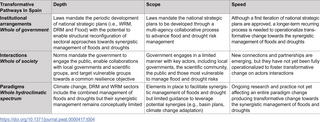
The example of Spain is used to illustrate how efforts towards change in hydroclimatic risk management unfold in practice. Spain has developed important legal and institutional instruments to enable the synergistic management of floods and droughts. These include mandates for interagency collaboration in the development of WRM and DRM national strategic plans, the mandate to develop flood and drought risk management plans at the basin level, and recent climate change regulations and programs incentivizing the inclusive management of hydroclimatic risks [104,140,145]. Despite notable improvements in enabling in depth and system-wide change, the synergistic management of floods and drought is not fully operational in Spain. This highlights the epic level of continuous effort required to break silos across sectors and transform governance to manage hydroclimatic risks. This finding is consistent with Termeer et al., (2024) who argue that the three elements of transformational change (i.e., depth, scope and speed) cannot be achieved simultaneously due to trade-offs [31]. The example of Spain supports the argument that in-depth and system-wide change, such as fostering interagency collaboration or restructure public service delivery, requires long-term commitment and iterative efforts. The results of the application of transformative pathways in the illustrative case of Spain and how they relate to the dimensions of change is summarized in Table 4 below.
Applying the proposed transformative governance conceptual framework to the illustrative case of Spain, suggests that this approach could be instrumental in evaluating change towards the synergistic management of floods and drought. By disaggregating each pathway into the dimensions of depth, scope and speed, it becomes possible to identify areas where progress is being made and where additional emphasis may be needed to catalyze transformative change. These dimensions can be assessed through a literature review, as demonstrated in this paper, or through a participatory co-creation processes involving flood and drought managers across government and society [32,62]. In such cases, the transformational pathways can be used to support a collaborative self-assessment and structured policy dialogue on context-specific strategies for advancing transformations.
While the transformational pathways are valuable for capturing the overall direction and maturity of change, they provide limited guidance on key aspects such as particular actions to enable change, enablers and barriers to change or indicators to measure success [19,50,57]. Further research is needed to advance the operationalization of these transformational pathways into a comprehensive and practical methodology that can support the implementation of transformational change toward the synergistic management of floods and droughts.
Conclusion
In order to synergistically manage floods and droughts, governance systems need to transform. Transformational pathways focused on interagency collaboration, enabling government and society to work together towards the same resilience objective, and adopting paradigms that conceptualize floods and droughts as interconnected ends of the same hydroclimatic spectrum, can be instrumental in furthering the changes needed to operationalize synergies in flood and drought management. The application of transformational pathways to the illustrative example of Spain suggests that this approach can serve as a useful conceptual framework for examining how transformational change unfolds in practice.
Moving forward, further research is needed to operationalize this conceptual framework by placing attention on the conditions required to enable and maintain changes in governance systems, the indicators and benchmarks to measure improvements, and the preconditions and barriers to implementation. Importantly, transformation should be viewed not as a fixed end point but as a continuous process. Emphasis should be placed on the interventions required to further governance systems, enable interagency collaboration, and lead society in the continuous effort of managing flood and drought risks synergistically.
We hope that this paper contributes to the ongoing conversation on transformational change, particularly as it applies to the synergistic management of floods and droughts. While there is pressing need for practical methodologies and real-word operationalization of this approach, the conceptual framework presented here aims to provide a structured lens through which to identify, in a disaggregated manner, areas where change is ongoing and areas where further efforts are needed to advance transformations. The synergistic management of floods and droughts is a complex endeavor with the potential of delivering much needed resilience to increasing climate change-induced risks. The conceptual framework presented here is intended to support practitioners advancing governance frameworks towards a more livable and prosperous future.
Acknowledgments
The authors gratefully acknowledge the PLOS Water editor Dr. Majid Shafiee-Jood and anonymous reviewer, Dr. Lucia De Stefano, Dr. Catrien Termeer, Dr. Greg Browder, and Dr. Nathan Engle for their excellent comments. Ana Nunez Sanchez, Greg Browder and Nathan Engle are key authors of the technical report “An EPIC Response: Innovative Governance for Flood and Drought Risk Management.” This article builds on some elements of this report and provides a broader theoretical foundation on transformational change incorporating key dimensions such as depth, scope and speed. This paper also includes a scholarly synthesis of the literature concerning the governance of flood and drought risk management.
References
- 1. He X, Pan M, Wei Z, Wood E, Sheffield J. A Global Drought and Flood Catalogue from 1950 to 2016. Bulletin of the American Meteorological Society. 2020;101(5):E508-35.
- 2. Kreibich H, Van Loon AF, Schröter K, Ward PJ, Mazzoleni M, Sairam N, et al. The challenge of unprecedented floods and droughts in risk management. Nature. 2022;608(7921):80–6. pmid:35922501
- 3.
Shepherd A, Mitchell T, Lewis K, Lenhardt A, Jones L, Scott L. The geography of poverty, disasters and climate extremes in 2030. 2013.
- 4.
CRED. Disasters in numbers [Internet]. 2022. Available from: https://www.cred.be/disasters-numbers-2021
- 5.
UNESCO. Best Practices on Flood and Drought Risk Management. 2023.
- 6.
UNISDR, CRED. The human cost of weather-related disasters 1995-2015. 2015.
- 7.
Browder G, Nunez Sanchez A, Jongman B, Engle N, van Beek E, Castera Errea M, et al. An EPIC Response: Innovative Governance for Flood and Drought Risk Management [Internet]. World Bank; 2021 [cited 2023 Feb 13]. Available from: http://elibrary.worldbank.org/doi/book/10.1596/35754
- 8.
World Economic Forum. The Global Risks Report 202318th Edition Insight Report [Internet]. World Economic Forum; 2023. Available from: https://www3.weforum.org/docs/WEF_Global_Risks_Report_2023.pdf
- 9. Grobicki A, MacLeod F, Pischke F. Integrated policies and practices for flood and drought risk management. Water Policy. 2015;17(S1):180–94.
- 10. Lemos M, Eakin H, Dilling L, Worl J. Social Sciences, Weather, and Climate Change. Meteorological Monographs. 2018;59:26.1-26.25.
- 11. Barendrecht M, Matanó A, Mendoza H, Weesie R, Rohse M, Koehler J. Exploring drought‐to‐flood interactions and dynamics: A global case review. WIREs Water. 2024;:e1726.
- 12.
Damania R, Desbureaux S, Hyland M, Islam A, Moore S, Russ J. Uncharted Waters. 2017.
- 13. King-Okumu C, Jillo B, Kinyanjui J, Jarso I. Devolving water governance in the Kenyan arid lands: from top-down drought and flood emergency response to locally driven water resource development planning. International Journal of Water Resources Development. 2018;34(4):675–97.
- 14.
United Nations Office for Disaster Risk Reduction. Our world at risk: transforming governance for a resilient future. Geneva: United Nations. 2022.
- 15.
IPCC. Climate change 2014: impacts, adaptation, and vulnerability: Working Group II contribution to the fifth assessment report of the Intergovernmental Panel on Climate Change. New York, NY: Cambridge University Press. 2014.
- 16.
World Bank. What the future has in store_Overview for policy makers.pdf. 2023.
- 17.
IPCC. Summary for Policymakers: Climate Change 2021: The Physical Science Basis. Contribution of Working Group I to the Sixth Assessment Report of the Intergovernmental Panel on Climate Change. 2021.
- 18.
IPCC. Climate Change 2022: Impacts, Adaptation and Vulnerability. Contribution of Working Group II to the Sixth Assessment Report of the Intergovernmental Panel on Climate Change [Internet]. Cambridge University Press, Cambridge, UK and New York, NY, USA; 2022. Available from: https://www.ipcc.ch/report/ar6/wg2/chapter/chapter-1/
- 19. Bartholomeus R, Van Der Wiel K, Van Loon A, Van Huijgevoort M, Van Vliet M, Mens M. Managing water across the flood-drought spectrum – experiences from and challenges for the Netherlands. Camb prisms Water. 2023;:1–22.
- 20. Djalante R, Holley C, Thomalla F. Adaptive governance and managing resilience to natural hazards. Int J Disaster Risk Sci. 2011;2(4):1–14.
- 21. Engle N, Johns O, Lemos M, Nelson D. Integrated and adaptive management of water resources: tensions, legacies, and the next best thing. E&S. 2011;16(1):art19.
- 22. Kosow H, Kirschke S, Borchardt D, Cullmann J, Guillaume J, Hannah D. Scenarios of water extremes: Framing ways forward for wicked problems. Hydrological Processes. 2022;36(2):e14492.
- 23. Milly P, Betancourt J, Falkenmark M, Hirsch R, Kundzewicz Z, Lettenmaier D. Stationarity is dead: whither water management?. Science. 2008;319(5863):573–4.
- 24. Hagenlocher M, Naumann G, Meza I, Blauhut V, Cotti D, Döll P, et al. Tackling Growing Drought Risks—The Need for a Systemic Perspective. Earth’s Future. 2023;11(9):e2023EF003857.
- 25. Ward P, de Ruiter M, Mård J, Schröter K, Van Loon A, Veldkamp T. The need to integrate flood and drought disaster risk reduction strategies. Water Security. 2020;11:100070.
- 26. Hurlbert M, Gupta J. Adaptive governance, uncertainty, and risk: policy framing and responses to climate change, drought, and flood: adaptive governance, uncertainty, and climate change. Risk Analysis. 2016;36(2):339–56.
- 27. Kates R, Travis W, Wilbanks T. Transformational adaptation when incremental adaptations to climate change are insufficient. Proc Natl Acad Sci USA. 2012;109(19).
- 28. Feola G. Societal transformation in response to global environmental change: A review of emerging concepts. Ambio. 2015;44(5):376–90. pmid:25431335
- 29. Pelling M, O’Brien K, Matyas D. Adaptation and transformation. Climatic Change. 2015;133(1):113–27.
- 30. Termeer C, Dewulf A. A small wins framework to overcome the evaluation paradox of governing wicked problems. Policy and Society. 2019;38(2):298–314.
- 31. Termeer K, Dewulf A, Biesbroek R. Three archetypical governance pathways for transformative change toward sustainability. Current Opinion in Environmental Sustainability. 2024;71:101479.
- 32. Woodhouse P, Muller M. Water governance—an historical perspective on current debates. World Development. 2017;92:225–41.
- 33. Biswas A. Integrated water resources management: is it working?. International Journal of Water Resources Development. 2008;24(1):5–22.
- 34. Andersson K, Ostrom E. Analyzing decentralized resource regimes from a polycentric perspective. Policy Sciences. 2008;41(1):71–93.
- 35. McCord P, Dell’Angelo J, Baldwin E, Evans T. Polycentric transformation in Kenyan water governance: A dynamic analysis of institutional and social-ecological change. Policy Studies Journal. 2017;45(4):633–58.
- 36. Pahl-Wostl C. Transitions towards adaptive management of water facing climate and global change. Water Resour Manage. 2006;21(1):49–62.
- 37. Pahl-Wostl C, Jeffrey P, Isendahl N, Brugnach M. Maturing the new water management paradigm: progressing from aspiration to practice. Water Resour Manage. 2011;25(3):837–56.
- 38.
Koehler J. Not all risks are equal: a risk governance framework for assessing the water SDG. 2023.
- 39.
Ostrom E. Understanding Institutional Diversity [Internet]. Princeton University Press; 2009 [cited 2023 Aug 31]. Available from: http://www.jstor.org/stable/10.2307/j.ctt7s7wm
- 40. Ostrom E. A general framework for analyzing sustainability of social-ecological systems. Science. 2009;325(5939):419–22. pmid:19628857
- 41. Engle N, Johns O, Lemos M, Nelson D. Integrated and adaptive management of water resources: tensions, legacies, and the next best thing. Ecology and Society. 2011;16(1).
- 42. Ostrom E. Beyond markets and states: Polycentric governance of complex economic systems. American Economic Review. 2010;100(3):641–72.
- 43. Pahl-Wostl C. A conceptual framework for analysing adaptive capacity and multi-level learning processes in resource governance regimes. Global Environmental Change. 2009;19(3):354–65.
- 44. Knieper C, Pahl-Wostl C. A comparative analysis of water governance, water management, and environmental performance in river basins. Water Resources Management. 2016;30(7):2161–77.
- 45.
Jedd T, Schutz A, Burbach M. Polycentric governance in Nebraska, U.S., for ground and surface water. In: Rouillard J, Babbitt C, Challies E, Rinaudo JD, editors. Water Resources Allocation and Agriculture [Internet]. IWA Publishing; 2022 [cited 2024 July 1]. p. 215–26. Available from: https://iwaponline.com/ebooks/book/857/chapter/2992995/Polycentric-governance-in-Nebraska-U-S-for-ground
- 46. Marshall G. Polycentricity, reciprocity, and farmer adoption of conservation practices under community-based governance. ECOLOGICAL ECONOMICS. 2009.
- 47. Baldwin E, McCord P, Dell’Angelo J, Evans T. Collective action in a polycentric water governance system. Env Pol Gov. 2018;28(4):212–22.
- 48. Villamayor‐Tomas S. Polycentricity in the water–energy nexus: A comparison of polycentric governance traits and implications for adaptive capacity of water user associations in Spain. Env Pol Gov. 2018;28(4):252–68.
- 49. Vij S. Polycentric disaster governance in a federalising Nepal: interplay between people, bureaucracy and political leadership. Policy Sciences. 2023.
- 50. Pahl-Wostl C, Knieper C. Pathways towards improved water governance: The role of polycentric governance systems and vertical and horizontal coordination. Environmental Science & Policy. 2023;144:151–61.
- 51. Pischke F, Stefanski R. Drought management policies – from global collaboration to national action. Water Policy. 2016;18.
- 52.
Sayers P. Drought risk management: a strategic approach. UNESCO. 2016.
- 53. Raikes J, Smith T, Jacobson C, Baldwin C. Pre-disaster planning and preparedness for floods and droughts: A systematic review. International Journal of Disaster Risk Reduction. 2019;38:101207.
- 54.
Field C, Barros V, Stocker T, Dahe Q, editors. Managing the Risks of Extreme Events and Disasters to Advance Climate Change Adaptation: Special Report of the Intergovernmental Panel on Climate Change [Internet]. 1st ed. Cambridge University Press; 2012 [cited 2023 Oct 26]. Available from: https://www.cambridge.org/core/product/identifier/9781139177245/type/book
- 55. Wilhite D. Combating drought through preparedness. Natural Resources Forum. 2002;26(4):275–85.
- 56. Pahl-Wostl C, Becker G, Knieper C, Sendzimir J. How multilevel societal learning processes facilitate transformative change: A comparative case study analysis on flood management. E&S. 2013;18(4):art58.
- 57. Pahl-Wostl C, Odume O, Scholz G, De Villiers A, Amankwaa EF. The role of crises in transformative change towards sustainability. Ecosystems and People. 2023;19(1):2188087.
- 58. Lara Á, Moral L. Nature-based solutions to hydro-climatic risks: Barriers and triggers for their implementation in Seville (Spain). Land. 2022;11(6):868.
- 59.
United Nations Office for Disaster Risk Reduction. Sendai Framework for Disaster Risk Reduction 2015 - 2030. 2015.
- 60.
Basabe P. Hyogo Framework for Action 2005–2015. In: Bobrowsky PT, editor. Encyclopedia of Natural Hazards [Internet]. Dordrecht: Springer Netherlands; 2013 [cited 2023 June 8]. p. 508–16. (Encyclopedia of Earth Sciences Series). Available from: http://link.springer.com/10.1007/978-1-4020-4399-4_180
- 61.
Pearce L. Disaster Management and Community Planning, and Public Participation: How to Achieve Sustainable Hazard Mitigation. 2002.
- 62.
World Bank. Building-Social-Resilience-Protecting-and-Empowering-Those-Most-at-Risk_Wolrd Bank_2015.pdf [Internet]. 2015. Available from: file:///C:/Users/nunezsan/OneDrive%20-%20Stichting%20Deltares/Documents/PhD/Literature%20Review/Building-Social-Resilience-Protecting-and-Empowering-Those-Most-at-Risk_Wolrd%20Bank_2015.pdf
- 63. de Ruiter M, Couasnon A, Ward P. Breaking the silos: an online serious game for multi-risk disaster risk reduction (DRR) management. Geosci Commun. 2021;4(3):383–97.
- 64. Leitner M, Babcicky P, Schinko T, Glas N. The status of climate risk management in Austria: assessing the governance landscape and proposing ways forward for comprehensively managing flood and drought risk. Clim Risk Manag. 2020;30:100246.
- 65.
Holling C, editor. Adaptive environmental assessment and management. [Laxenburg, Austria]: Chichester; New York: International Institute for Applied Systems Analysis; Wiley; 1973. 377 p. (International series on applied systems analysis).
- 66.
United Nations Environment Programme. Adaptation Gap Report 2022: Too Little, Too Slow – Climate adaptation failure puts world at risk. 2022; Available from: https://www.unep.org/adaptation-gap-report-2022
- 67.
United Nations Environment Programme, Bueno Rubial M, Magnan A, Christiansen L, Neufeldt H, Hammill A, et al. Adaptation Gap Report 2024: Come hell and high water - As fires and floods hit the poor hardest, it is time for the world to step up adaptation actions [Internet]. United Nations Environment Programme; 2024 [cited 2025 June 12]. Available from: https://wedocs.unep.org/20.500.11822/46497
- 68. Huitema D, Mostert E, Egas W, Moellenkamp S, Pahl-Wostl C, Yalcin R. Adaptive water governance: assessing the institutional prescriptions of adaptive (co-)management from a governance perspective and defining a research agenda. Ecol Soc. 2009;14(1):art26.
- 69. Frohlich M, Jacobson C, Fidelman P, Smith T. The relationship between adaptive management of social-ecological systems and law: a systematic review. E&S. 2018;23(2):art23.
- 70. Douville H, Allan R, Arias P, Betts R, Caretta M, Cherchi A, et al. Water remains a blind spot in climate change policies. PLOS Water. 2022;1(12):e0000058.
- 71. Rittel H, Webber M. Dilemmas in a general theory of planning. Policy Sciences. 1973;4(2):155–69.
- 72.
Roberts N. Wicked problems and network approaches to resolution. 2000;1(1).
- 73. Wise R, Fazey I, Stafford Smith M, Park S, Eakin H, Archer Van Garderen E. Reconceptualising adaptation to climate change as part of pathways of change and response. Global Environmental Change. 2014;28:325–36.
- 74. Jordan A, Huitema D, Hildén M, Van Asselt H, Rayner T, Schoenefeld J. Emergence of polycentric climate governance and its future prospects. Nature Clim Change. 2015;5(11):977–82.
- 75. Rayner T, Jordan A. The European Union: the polycentric climate policy leader?. WIREs Climate Change. 2013;4(2):75–90.
- 76.
Ministerio de Igualdad. Riesgos climáticos desde la perspectiva de género. 2021.
- 77.
Gupta J, Termeer K, Klostermann J, Meijerink S, Jong P, Nooteboom S. The Adaptive Capacity Wheel: A Method to Assess the Inherent Characteristics of Institutions to Enable the Adaptive Capacity of Society. 2010.
- 78. Estrela T, Sancho T. Drought management policies in Spain and the European Union: from traditional emergency actions to Drought Management Plans. Water Policy. 2016;18(S2):153–76.
- 79. Liu J, Yang H. Spatially explicit assessment of global consumptive water uses in cropland: Green and blue water. Journal of Hydrology. 2010;384(3–4):187–97.
- 80.
World Bank. What the future has in store: A new paradigm for water storage. 2023.
- 81. Thorpe A, Rogers D. The Future of the Global Weather Enterprise: Opportunities and Risks. Bulletin of the American Meteorological Society. 2018;99(10):2003–8.
- 82. Jedd T, Smith K. Drought-stricken U.S. states have more comprehensive water-related hazard planning. Water Resour Manage. 2023;37(2):601–17.
- 83. Sivakumar M, Stefanski R, Bazza M, Zelaya S, Wilhite D, Magalhaes AR. High Level Meeting on National Drought Policy: Summary and Major Outcomes. Weather and Climate Extremes. 2014;3:126–32.
- 84.
IDMP. Drought Resilience Conference +10 Conclusions and Recommendations. 2024.
- 85.
Hochrainer-Stigler S. Toward a framework for systemic multi-hazard and multi-risk assessment and management. 2023.
- 86. Zscheischler J. Future climate risk from compound events. Nature Climate Change. 2018;8.
- 87. de Brito M. Compound and cascading drought impacts do not happen by chance: A proposal to quantify their relationships. Science of the Total Environment. 2021.
- 88. Alves P, Loc H, De Silva Y, Penny J, Babel M, Djordjévic S. The dual-risks context: A systematic literature review for the integrated management of flood and drought risks. International Journal of Disaster Risk Reduction. 2023;96:103905.
- 89.
Ostrom E. A polycentric approach for coping with climate change. 2009.
- 90. Berkhout F, Hertin J, Gann DM. Learning to adapt: organisational adaptation to climate change impacts. Climatic Change. 2006;78(1):135–56.
- 91. Termeer C, Dewulf A, Biesbroek G. Transformational change: governance interventions for climate change adaptation from a continuous change perspective. Journal of Environmental Planning and Management. 2017;60(4):558–76.
- 92. O’Brien K. Global environmental change II: From adaptation to deliberate transformation. Progress in Human Geography. 2012;36(5):667–76.
- 93. Vermaak H. Planning deep change through a series of small wins. AMPROC. 2013;2013(1):10947.
- 94. Burnes B. Complexity theories and organizational change. Int J Management Reviews. 2005;7(2):73–90.
- 95. Howes M, Tangney P, Reis K, Grant-Smith D, Heazle M, Bosomworth K. Towards networked governance: improving interagency communication and collaboration for disaster risk management and climate change adaptation in Australia. Journal of Environmental Planning and Management. 2015;58(5):757–76.
- 96. Karré P, Van der Steen M, Van Twist M. Joined-Up Government in The Netherlands: Experiences with Program Ministries. International Journal of Public Administration. 2013;36(1):63–73.
- 97. Hall JA, Weaver CP, Obeysekera J, Crowell M, Horton RM, Kopp RE, et al. Rising Sea Levels: Helping Decision-Makers Confront the Inevitable. Coast Manage. 2019;47(2):127–50. pmid:32665748
- 98.
Plan Hidrológico Nacional. 10/2001 2001.
- 99.
Sistema Nacional de Protección Civil [Internet]. 17/2015 2015. Available from: https://www.boe.es/boe/dias/2015/07/10/pdfs/BOE-A-2015-7730.pdf
- 100. Garrick D, De Stefano L, Fung F, Pittock J, Schlager E, New M, et al. Philosophical Transactions of the Royal Society A. 2013;371(2002):20120415.
- 101.
Modificacion Plan Hidrologico Nacional. 11/2005 2005.
- 102.
Estrategia Nacional de Protección Civil [Internet]. Orden PCI/488/2019 2019. Available from: https://www.boe.es/boe/dias/2019/04/30/pdfs/BOE-A-2019-6348.pdf
- 103.
Ministerio del Interior. Plan Estatal de Protección Civil ante el Riesgo de Inundaciones [Internet]. 2011. Available from: https://www.proteccioncivil.es/catalogo/naturales/plan-estatal-riesgo-inundaciones/plan/texto/PLAN%20ESTATAL%20INUNDACIONES.pdf
- 104. Paneque P. Drought management strategies in Spain. Water. 2015;7(12):6689–701.
- 105.
United Nations. Words into Action Guidelines Implementation Guide for Addressing Water-Related Disasters and Transboundary Cooperation: Integrating Disaster Risk Management with Water Management and Climate Change Adaptation [Internet]. UN; 2019 [cited 2023 July 27]. Available from: https://www.un-ilibrary.org/content/books/9789210474054
- 106.
Cook J, Freeman S, Levine E. Shifting course: Climate change for water management institutions. World Wildlife Fund. 2010.
- 107.
Espluga J, Subirats J. Participación ciudadana en las políticas de agua en España. 2008.
- 108. Mancilla García M, Hileman J, Bodin Ö, Nilsson A, Jacobi P. The unique role of municipalities in integrated watershed governance arrangements: a new research frontier. Ecol Soc. 2019;24(1):art28.
- 109. Hölscher K, Frantzeskaki N, Collier M, Connop S, Kooijman E, Lodder M. Strategies for mainstreaming nature-based solutions in urban governance capacities in ten European cities. npj Urban Sustain. 2023;3(1):54.
- 110.
Ley de Aguas [Internet]. 95/1985 1985. Available from: https://www.boe.es/boe/dias/1985/08/08/pdfs/A25123-25135.pdf
- 111.
Texto Refundido de la Ley de Aguas. Real Decreto Legislativo 1-2001 2001.
- 112.
Ministerio del Interior. Norma Basica de Protección Civil [Internet]. Real Decreto 407/9364 1992. Available from: https://www.boe.es/eli/es/rd/1992/04/24/407/dof/spa/pdf
- 113. Vargas Molina J. Análisis sobre el cumplimiento de los planes de emergencia por sequía para abastecimientos urbanos en Andalucía. Cuadernos Geográficos. 2020;59(2):241–62.
- 114. Vargas J, Paneque P. Challenges for the integration of water resource and drought-risk management in Spain. Sustainability. 2019;11(2):308.
- 115.
Water Framework Directive. 2000/60/EC Oct 23, 2000.
- 116.
Ministerio de la Presidencia. Evaluación y gestión de riesgos de inundación. 2010.
- 117.
Moreno J, Ortiz M, Aracil P. Análisis multidisciplinar para mitigar el impacto de los fenómenos climáticos extremos.
- 118.
Hernández-Mora N, Ballester A. Public participation and the role of social networks in the implementation of the water framework directive in Spain. 2011.
- 119.
Ortiz G, Aznar-Crespo P, Olcina-Sala Á. How social are flood risk management plans in Spain? In 2021 [cited 2024 Apr 25]. p. 65–75. Available from: http://library.witpress.com/viewpaper.asp?pcode=WS21-007-1
- 120.
Erman A, De Vries Robbe S, Thies S, Kabir K, Maruo M. Gender Dimensions of Disaster Risk and Resilience: Existing Evidence [Internet]. World Bank; 2021 [cited 2024 Apr 19]. Available from: http://elibrary.worldbank.org/doi/book/10.1596/35202
- 121.
Hallegate S, Bangalore M, Bonzanigo L. Shock waves: managing impacts of climate change on poverty. World Bank. 2015.
- 122. Hommes L, Vos J, Boelens R. The need to acknowledge, study and engage with new water justice movements. PLOS Water. 2023;2(5):e0000128.
- 123.
Ley de Protección Civil [Internet]. Ley 2/1985 1985. Available from: https://www.boe.es/boe/dias/1985/01/25/pdfs/A02092-02095.pdf
- 124.
MITERD. Guía para la elaboración de planes de emergencia en abastecimiento urbano. 2019.
- 125.
MITERD. Marco eficaz de gestión del riesgo de catástrofes en España. 2021.
- 126.
Gisbert M, Esteban C, Araico A. Género y cambio climático: un diagnóstico de la situación. Ministerio del Interior. 2020.
- 127.
Ley de Cambio Climático y Transición Energética. 2021.
- 128.
Ministerio de Igualdad. III Plan Estratégico para la Igualdad Effectiva de Mujeres y Hombres 2022-–2025 [Internet]. 2022. Available from: https://www.inmujeres.gob.es/publicacioneselectronicas/documentacion/Documentos/DE1824.pdf
- 129.
Ministerio de Inclusión, Seguridad Social, y Migraciones. Nota de Prensa: El Gobierno aprueba un amplio paquete de medidas extraordinarias de Seguridad Social para garantizar la protección de las personas afectadas por la DANA. 2024.
- 130. Daniels E, Bharwani S, Gerger Swartling Å, Vulturius G, Brandon K. Refocusing the climate services lens: Introducing a framework for co-designing “transdisciplinary knowledge integration processes” to build climate resilience. Climate Services. 2020;19:100181.
- 131.
Ministerio de Ciencia, Innovación y Universidades. Plan Estatal de Investigacion Científica, Técnica y de Innovacion 2024_2027 [Internet]. 2023. Available from: https://www.ciencia.gob.es/InfoGeneralPortal/documento/6e566243-bcb5-45d8-ab77-5cfe533060f2
- 132.
Strzepek K, Schlosser C, Goudreau J. Hydroclimatic analysis of climate change risks to global corporate assets in support of deep-dive valuation. 2021.
- 133. Di Baldassarre G, Martinez F, Kalantari Z, Viglione A. Drought and flood in the Anthropocene: feedback mechanisms in reservoir operation. Earth Syst Dynam. 2017;8(1):225–33.
- 134. Biella R, Mazzoleni M, Brandimarte L, Di Baldassarre G. Thinking systemically about climate services: using archetypes to reveal maladaptation. Climate Services. 2024;34:100490.
- 135.
Magnan A, Schipper E, Burkett M, Bharwani S, Burton I, Eriksen S. Addressing the risk of maladaptation to climate change. 2016.
- 136. Schipper E. Catching maladaptation before it happens. Nat Clim Chang. 2022;12(7):617–8.
- 137. Estrela T, Vargas E. Drought management plans in the European Union: The case of Spain. Water Resources Management. 2012;26(6):1537–53.
- 138.
Johannessen Å, Wamsler C. Extraordinary Governance to Avoid Extraordinary Events. In: Baird J, Plummer R, editors. Water Resilience [Internet]. Cham: Springer International Publishing; 2021 [cited 2023 Apr 24]. p. 263–90. Available from: http://link.springer.com/10.1007/978-3-030-48110-0_12
- 139. Sivakumar M, Motha R, Wilhite D, Qu J. Proceedings of an Expert Meeting July 14-15, 2011, Washington DC, USA. In: Washington DC, USA, 2011.
- 140. Garrick D. Decentralisation and drought adaptation: applying the subsidiarity principle in transboundary river basins. Int J Commons. 2018;12(1):301.
- 141.
Swyngedouw E. Liquid power: contested hydro-modernities in twentieth century Spain. 2015.
- 142.
MITERD. Plan Nacional de Adaptación al Cambio Climático 2021-2030. Madrid: Ministerio para la Transición Ecológica y el Reto Demográfico; 2020.
- 143.
MITERD. Strategic Orientation on Water and Climate Change [Internet]. 2022. Available from: https://www.miteco.gob.es/content/dam/miteco/es/agua/temas/sistema-espaniol-gestion-agua/estrategia/EATE-EN-Full-document%20.pdf
- 144.
MITERD. PIMA ADAPTA. Conocimiento y acción frente a los riesgos derivados del cambio climático. 2020; Available from: https://www.miteco.gob.es/content/dam/miteco/es/cambio-climatico/planes-y-estrategias/pimaadapta2020_tcm30-521929.pdf
- 145. De Stefano L, Hernandez-Mora N. Multi-level interactions in a context of political decentralization and evolving water-policy goals: the case of Spain. Reg Environ Change. 2018;18(6):1579–91.